

Dear Brothers and Sisters,
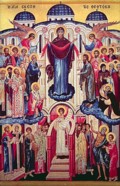
Congratulations with the feasts of the Resurrection of the Lord and the Deposition of the Sash of the Most Holy Mother of God!
Last week we briefly discussed the 148th psalm. Today, let us focus our attention on the 149th psalm ‘Praise ye the Lord,’ which is the second of the three Laudate psalms. Unfortunately, this beautiful, joyful, prophetic psalm of praise is usually completely omitted from the church services in parishes. In our parish, this psalm is read on weekdays of Great Lent, as well as on those rare occasions when we serve simple matins (in a couple of weeks we will serve simple matins when we celebrate the memory of the Martyrs Faith, Hope, and Charity).
We can assume that this psalm was composed some time after the Jews returned from captivity in Babylon. The unknown author calls the Israelites to sing a new song of praise to the Heavenly King in the reestablished temple, with the temple choir and musical instruments. The author notes that the Lord has saved His chosen nation from foes and returned them to the Promised Land because they had meekly repented of their sins while they were in exile. Since the Lord has freed them, the Jews can now rejoice “upon their beds” as well as take up the sword so as to punish the pagans. Although upon their return from Babylon the Jews did rebuild Jerusalem and the temple, their independence lasted but for a fleeting moment, after which there were once again military failures and subjugation by foreigners. Dreams of joyful rest and vengeance upon the heathen never materialized.
Most likely every nation, family, and individual has had, from time to time, such triumphant, hopeful thoughts as are expressed in this psalm. All I need to do is finish my studies, find a job, get married, buy a house, have a child, or retire and everything will finally fall into place, I will be content and will begin to live in the way about which I always dreamed. Of course, it never turns out this way. New problems arise, and once again we strive and work to achieve something new.
Blessed Augustine, in his explanation of the 149th psalm, pays absolutely no attention to the historical context of this psalm. Instead of this, he explains it in a mystical and prophetic key. It is abundantly clear that the hopes of the author were realized only in the New Testament Church and not here on earth, but in the Heavenly Kingdom. Therefore, let us strive to use our energy not so much to set up paradise here on earth, but to enter into the Eternal Kingdom. Blessed Augustine notes that the author of the 149th psalm calls us to glorify God with a new song as well as with “the timbrel and harp.” To play a musical instrument one must take it up in one’s hands and strum it, that is, a Christian is obliged to glorify God both with his voice as well as with good deeds. Through the prayers of the Holy Hierarch Augustine, may our Lord God settle us in the New Jerusalem where the New Israelites, that is, faithful followers of Christ, eternally rejoice.
Priest Alexis